
John Cotter’s memoir “Losing Music” is full of unanswered questions. The cause of his loss may be Meniere’s disease, but no one really understands Meniere’s and he may not have it. His disabling vertigo may be related to migraine, or it may not be. His tinnitus drives him crazy, then goes away, and inevitably returns.
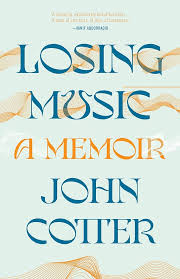
Hearing and vertigo loom large, and come close to defining his life, as they did mine when I wrote “Shouting Won’t Help”. His descriptions of vertigo are so accurate that just reading them nearly gave me vertigo as well. But it is the loss of music that is the undercurrent of the book: “What I feared losing—the catastrophe that the roaring shadowed forth—wasn’t just a series of structured sounds, but the world those sounds created, a world you could live inside: Bach on a snowy afternoon, hard blues on a long night’s drive, the background mood in a restaurant or at a party… Music is color… You feel it on your skin.” Cotter is not a musician, he’s a listener, and shares his eclectic passions with the reader.
Cotter’s hearing loss takes a form that is new to me. He has hearing aids but often hears better without them. His hearing fluctuates – more dramatically than the wobble I sometimes experience. Not only can he hear from time to time without hearing aids, he also sometimes cannot hear even with them.
The book is loosely structured and swirls around Meniere’s, much as Meniere’s swirls around those who suffer from it. Hearing comes and goes, tinnitus washes in and recedes, vertigo is always in the wings, hovering. A whirling to the right, then flat on the bed or the floor or whatever is closest, eyes closed, don’t try to turn over. Figure out where vomiting will be the least offensive.
Cotter is a lyrical writer. “I had one good ear that afternoon, and it let me hear [his friend’s] voice. What I also heard: the brush of my feet in grass and dry leaves and the pops of breaking twigs. Wind: the stop and start of it you can’t predict, or control. Skittering insects, chirps of forty birds, fifty clicks, chitters, squees, throat clearing, a rusty hinge squeal, a piping, pinched flutes, calls like a finger on a wet glass, return calls. The green insect almost too small to see—you couldn’t make out its shape, just a speck of green.”
“Losing Music” is a thoughtful account of life-altering events, and a probing into a medical mystery, mostly unsolved. There are detours, some of them lengthy. Jonathan Swift, who may have suffered from Meniere’s, gets a chapter to himself. The title, “The Hundred Oceans of Jonathan Swift,” refers to Swift’s use of water metaphors to describe the sounds in his ears — oceans, or the “noise of seven Watermills.” The occasional brutal fact pops up: The British explorer John Speke, convinced that the buzzing in his ear was an insect, stabbed himself in the eardrum to get rid of it. The Mayo Clinic does not come off favorably.
I do hope readers don’t accept his assessment of cochlear implants. Someday, he says, he’ll get cochlear implants “installed.” He isn’t hopeful. “Implants aren’t like real sound – for the majority of users, they’re far worse than real sound — so I can’t help but dread the day.” I think the vast majority of cochlear-implant users would disagree. He’s right that the moment of activation can be jarring. But with time and practice, the brain comes to hear the digital cochlear-implant signals as normal sound. They do not do as well with music, so Cotter’s fears are not entirely unfounded. But I know dozens of people with cochlear implants, including professional musicians. I don’t know anyone who regrets the decision to get them.
Discover more from Katherine Bouton: Smart Hearing
Subscribe to get the latest posts sent to your email.

 Katherine Bouton: Smart Hearing
I am a former professional musician whose performing career ended prematurely because of my hearing loss twenty-seven years ago. By 2021 my hearing loss had progressed to a point at which my audiologist said that I had gone as far as I could with hearing aids, and recommended a cochlear implant. After getting a second opinion and trying auditory training, I made the decision to get an implant, a decision I have never regretted. Not only do I understand speech much better, but to my surprise, after a period of adjustment, I enjoy music more than I did with my hearing aids.
LikeLike
Thank you Jon. That’s really encouraging news. I know that cochlear implant manufacturers are making hearing music a priority.
LikeLike
I too hope that people will remain positive in considering a cochlear implant. I lost my hearing gradually and then became completely deaf and could not hear a single sound for 15 years. I received a cochlear implant 2 1/2 years ago and it has been life-changing. Not only can I converse with 95% sentence comprehension, I can now hear music. The more I listen, the better it gets. I would say my ability to hear music is about 80% of what it was before I lost any hearing. I also experienced significant vertigo but with balance therapy, it seems to have subsided.
LikeLike
Thanks Toni, those are impressive numbers.
LikeLike
as i see further loss of hearing ahead for me, and my aids not being all they could be .., at all!.., and seeing how I am best alone.., knowing that is not the answer! and music is indeed one of our deepest pleasures.., I am wondering about cochlear implants.. ., yet dreading the change.., these sharings have been so helpful and supportive. Thanks for all you do, Katherine!
LikeLike
Try the cochlear implant. They’ll do the worse ear first so you will still have the hearing aid if you don’t like the c.i. But don’t give up on it too quickly — it takes lots of training for your ears to understand those news sounds.
Thanks for your nice comment.
LikeLike
thank you for your reply, Katherine! and vote of confidence! so far, I am told i have not lost enough hearingto consider CI. I am in VT, [ and went to the bookstore in Norwich when you came to give a talk andbought your book] !and I am going to get to the Brattleboro hearing center that measures ‘real hearing’ to perhaps get new aids. also looking at telecoil assists etc.
LikeLike
I have one cochlear implant, along with a strong Phonak hearing aid. I hear better than I have in years. Others notice, too, that my hearing is better. It was either an implant or the amplication of what I could already hear — which wasn’t much. I deeply thank Dorothy Gallagher for putting us in touch.
LikeLike
Thank you for posting about this book. I just finished reading it, and it’s unlikely I would’ve known about this memoir otherwise.
LikeLike