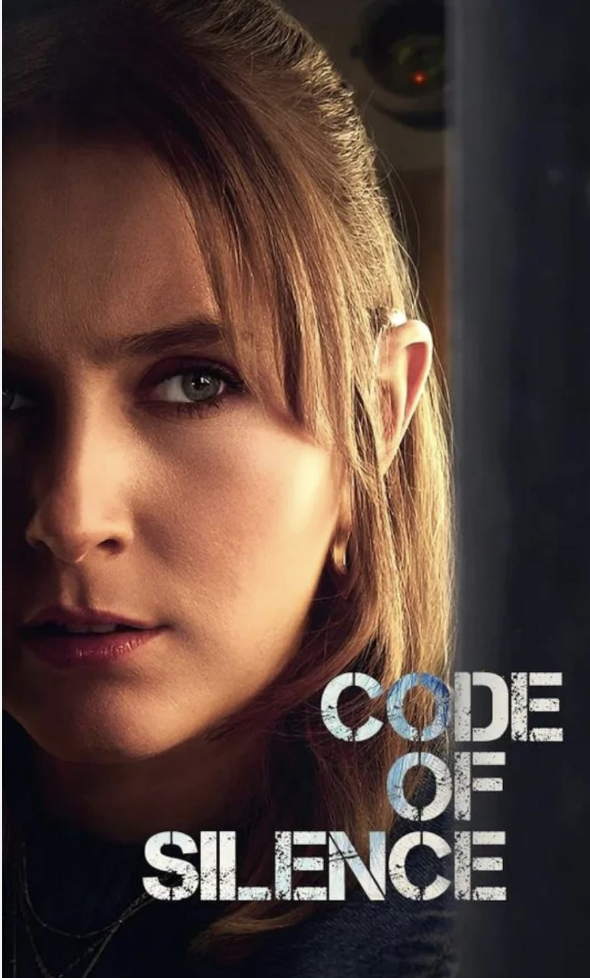
In the new British drama Code of Silence, streaming on BritBox, deafness plays a central motivating role – and an invaluable asset. Rose Ayling-Ellis plays Alison Brooks, a 29-year-old deaf woman who works in the canteen of the local police station. When professional lipreaders, trained as Forensic Lipreaders, are not available at a crucial moment in the investigation of a brutal gang planning a major robbery, the detectives ask if Alison can help.
Alison’s jobs at the canteen and a second job as a bartender are well below her skills. Her deafness is a factor in her underemployment. But this is not a show about victimization. Alison is strong willed, a force to be dealt with rather than pandered to. Condescension about her deafness is Alison’s motivation. Explaining to another character why she took on this dangerous job, she says. “I really like working hard. And all I wanted was for someone to give me a chance – the same chance as anyone else.” Her lipreading is not a crutch but an invaluable skill, as the police soon realize.
I’m not Deaf and I don’t sign, but the experience of deafness and hearing loss often overlap, and Code of Silence gets it exactly right. Ayling-Ellis is a British actress (American viewers might remember her from EastEnders), who is Deaf, wears prominent hearing aids, and both signs and speaks – as does her character Alison. She has been Deaf since birth and is a British Sign Language user. Catherine Moulton, the show’s creator, is partially deaf herself and took lipreading lessons, which gave her the idea for this series. The actress who plays Alison’s mother, Fifi Garfield (who is terrific), and the actor who plays her recently jilted boyfriend, Rolf Choutan, are also Deaf. So it shouldn’t be a surprise that the show feels not only authentic about the Deaf experience, but also positive.
Most interesting to me is Alison’s lipreading. We see the speaker through her eyes. Superimposed on the screen is a phonetic version of what she sees. Vowels and consonants gradually turn into recognizable words and then phrases. If a word, a proper name for instance, isn’t something she recognizes, she tells the others what it sounds like. In Episode 3, a new person joins the robbery gang. Alison tries to lipread her name but can only get as far as that it begins with an M or B and ends with an SH. She sounds out the word phonetically and after a few guesses the investigators realize the name is Chandra Bakshi, an employee of the mogul the gang plans to rob, recruited by the gang.
At one point, Alison’s boyfriend, who is also a member of the gang and who Alison has been surveilling for the police, asks about lipreading. How does it work? Aside from the fact that he shouldn’t be her boyfriend, that he shouldn’t know she can lipread, and that she knows she’s in danger of being outed and possibly killed, she explains. You watch carefully, she says. You imagine the sounds coming out of their mouth. “It’s other stuff too, it’s like a great big puzzle.” Body language is part of lipreading, she says, someone leans in when they’re asking a question, leans back to listen. The biggest insight into lipreading, however, are the screen captions that show the initial garbled information resolve into consonants and vowels and then familiar words and finally into a sentence or phrase. “Lipreading” is the term used in the series but as Alison’s explanation shows, “speechreading” is a more accurate term.
I’m a good lipreader, though I need sound in addition to a clear view of the speaker’s face, but I had never analyzed exactly what the brain is doing, how phonetic signals resolve into recognizable words. I hope this doesn’t make the show sound dutiful or expository. It’s a nail-biting thriller, and totally entertaining.
You can find the show on BritBox, a streaming service. I accessed it as an add-on to Amazon Prime Video, but there are other ways to get it. Code of Silence’s first season is 6 episodes, with a second season planned. I can’t wait.
*
For more about hearing loss and hearing help, read my books SHOUTING WON’T HELP and SMART HEARING, available as paperback or ebook at Amazon.
Discover more from Katherine Bouton: Smart Hearing
Subscribe to get the latest posts sent to your email.

 Katherine Bouton: Smart Hearing
BritBox is the only streaming service for me. With the quality and quantity of content — actors, scripts, settings, ensembles, etc. — I don’t need any others. While Code of Silence is pretty engaging, it’s almost painful for me to watch the main character make so many stupid decisions.
LikeLike
Yes, she is reckless, and I did a lot of cringing. But i think it’s part of how she is trying break away from being locked in by her deafness.
LikeLike
I know these types of shows have “artistic license”, but in reality reading someone’s lips from 25 meters away is very much an exaggeration. Also since only about 20% of the English language appears on the lips, it is an 80% guessing game that you just can’t get 100% right all the time. I have been profoundly deaf for 40 years and hearing aids just don’t work. They obviously do for this person so she is not profoundly deaf.
LikeLike
I don’t think the show makes any claim that she is profoundly deaf. Many people, even those who sign and consider themselves part of Deaf culture can hear a little. That doesn’t mean they aren’t deaf. Sometimes hearing aids help, sometimes cochlear implants help, but people who have those devices — like me and so many other late-deafened people I know — still have very compromised hearing. That’s why we need captions. A signing Deaf person who has hearing aids also still needs captions — or sign. Cochlear implants do generally work for people who are profoundly deaf. They’re not perfect. They don’t give you “normal” hearing. As for lipreading at that distance — I agree it’s probably not doable — but who knows? People have all degrees of hearing and hearing loss, no two people will ever “hear” exactly the same thing. And it is a TV series after all. But it gets a lot right. Thanks for your thoughts on this.
LikeLike
It used to be that people who have hearing difficulty were called Hard of Hearing (HOH) and those who are deaf were called deaf, But I suspect that has changed now?
LikeLike
Terrific post, Katherine. I assume you want it included
LikeLike
Hi Gail, Thank you! Yes, I’m really going to try to get back to more regular blogging, but for now at least I have this one.
LikeLike
For those who are wondering who Gail is, she’s the editor of HLAA’s New York City chapter’s excellent newsletter. You can sign up for it by asking to be added to our mailing list — hearinglossnyc.org.
LikeLike
jJust finished watching the first episode. Loved it. Linda Martinez, Frederick MD
LikeLike
Thanks for sharing that!
LikeLike