
When my dog was a puppy he slept in a crate, then he moved to a chair, then onto the bed. My husband would pick him up like a little lamb, when he came to bed after me, and move the dog back to the chair. After my husband died, Oliver moved permanently to the bed. I found it comforting, but more than that I also found it made me feel safer.
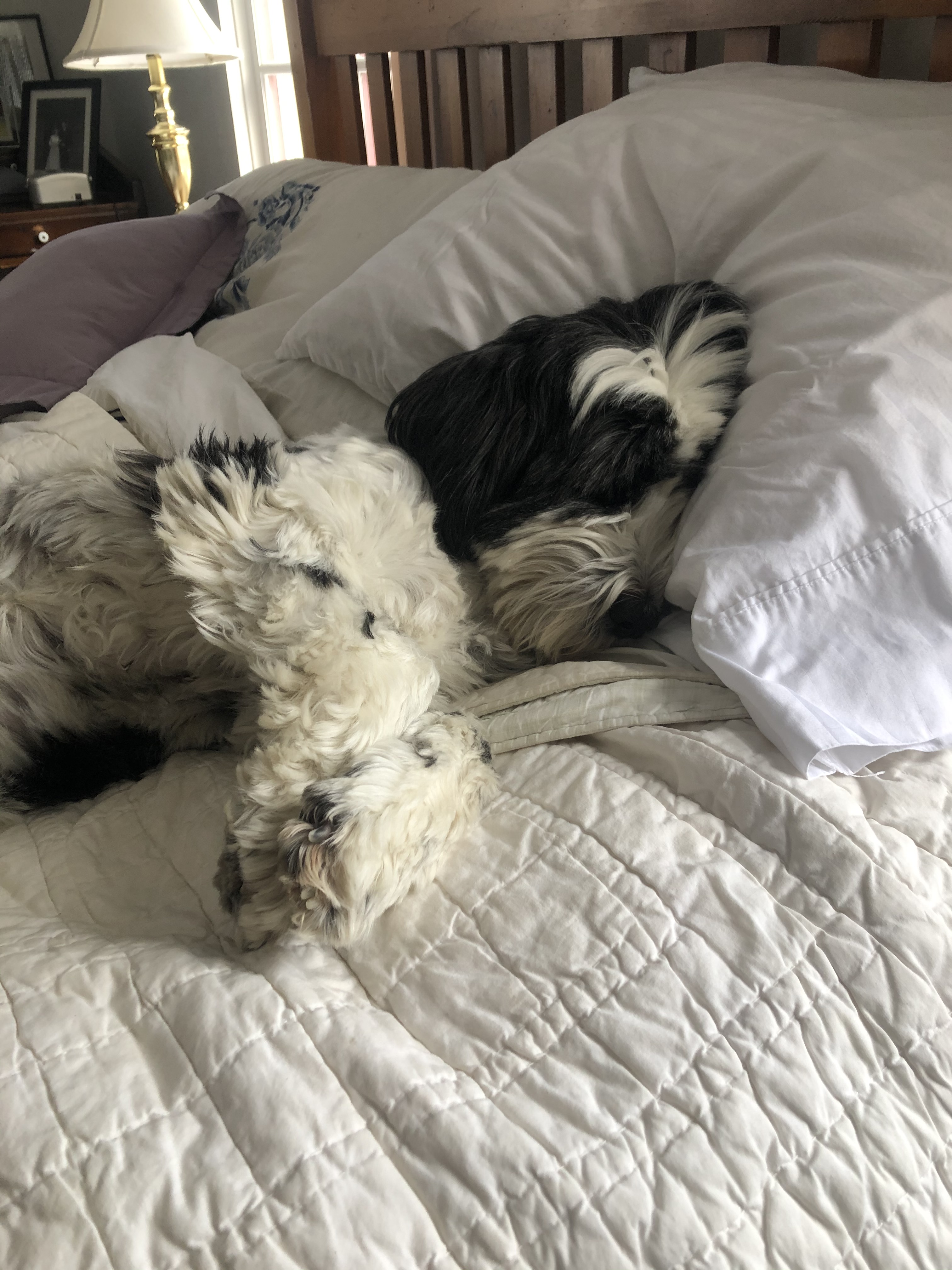
Oliver is a Tibetan Terrier, a 30-pound male with a good bark. Tibetan Terriers are not actually terriers but relatives of the Lhasa Apso and Shi Tsu, and they were originally bred as Tibetan temple dogs. They guarded the temple against intruders, sounding the alarm that would alert the larger fiercer dogs, who perhaps didn’t hear as well.
Oliver serves that purpose for me too, though I don’t have the backup fierce dogs. At my house in the country, he barks at anyone who drives or walks up the driveway, which prompts me to go to the door to see who it is. In the city, he barks when someone knocks. I don’t discourage this, although it can be annoying to people arriving. I have trained him to calm down if I tell him to, but only after I’ve determined who the visitor is.
He also barks when the phone rings, which can be handy since I don’t always hear it. This is also a response to a perceived intrusion. In my New York building, the doorman calls on the phone when we have a guest. Ollie associates any phone call with the arrival of a guest.
I wouldn’t rely on Ollie for other kinds of alerts. He is not a trained hearing dog. But we have an alarm system, and the smoke detectors are wired so that an alarm that goes off anywhere in the house sets the others off as well. Smoke in the kitchen, which I’d probably never notice from the bedroom, sets off the kitchen alarm (which I probably wouldn’t hear) and that alarm sets off the others. I’m pretty sure I could not sleep through the alarm ten feet from my bed. But just to be sure I now have an alarm with strobe lights.
Ollie started out at the foot of the bed. Over the weeks after my husband’s death, he gradually crept up so he now he curls up against the pillows. (He’s not under the covers, and won’t be. I do have a few standards.) He’s a good sleeper and doesn’t bother me unless he thinks he’s detected an intruder, which in his case could be a deer walking through the yard or a bear knocking over the neighbor’s trashcan. I get up and look around, if he’s persistent enough. But mostly I mumble for him to settle down and I fall back asleep.
A few years ago, the Times ran an article called “Out of the Doghouse, Into the Bed.” The photos accompanying the story were very funny. The writer, Jen A. Miller, was reporting on a study from the Mayo Clinic in Phoenix. The study subjects were 40 dogs who slept in the bedroom with their owners. The dogs wore a FitBark (an activity tracker, cousin to the FitBit) and the humans wore an Activwatch2, also an activity tracker, made by Samsung, and kept a sleep diary. People slept slightly better when the dog was not on the bed, dogs slept about the same.
Not all dogs belong on the bed, or even in the bedroom. But mine is a cosy furry affectionate watchdog. We both sleep better this way.
For more about living with hearing loss, read my books “Smart Hearing: Strategies, Skills and Resources for Living Better With Hearing Loss” and “Shouting Won’t Help: Why I and 50 Million Other Americans Can’t Hear You.” Both are available as ebook and paperback on Amazon.com.
Is this post sounds familiar, congratulations on your memory. It was originally published in 2021. I’d forgotten I ever wrote it, and if I forgot, I figured others might too. It’s one of my favorites.
Discover more from Katherine Bouton: Smart Hearing
Subscribe to get the latest posts sent to your email.

 Katherine Bouton: Smart Hearing
Willie Jane Keyes-Sterling, thank you so much for your lovely comment, which I accidentally trashed and can’t retrieve.
LikeLike
This post is lovely!
LikeLike