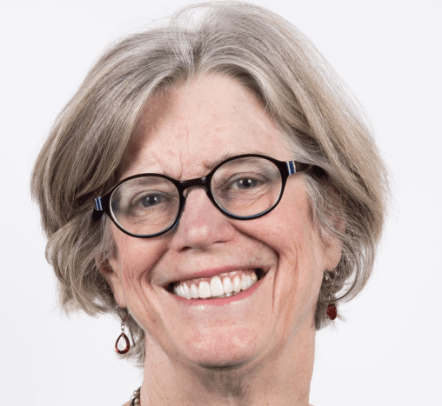
This post is adapted from my acceptance speech for the Ruth Green Advocacy Award given by the Center for Hearing and Communication. To read more about CHC go to chchearing.org. To hear more about The New York City Chapter of the Hearing Loss Association of America, of which I’m the president, go to hearinglossnyc.org.
My advocacy started as self-preservation. When I finally had to acknowledge the severity of my hearing loss, I realized that if my hearing was not going to get better, the world would have to.
I remember walking through Grand Central Station one day past a lecture on New York City architecture with a huge screen and beautiful pictures – and loud, muffled, and incomprehensible sound. Why aren’t there captions? I thought.
And then shortly after, I found HLAA and people who were advocating for just that – captions in public spaces. I’ve been the President of our New York City Chapter since 2015, with a pandemic term off. Through our monthly programs and information on our website, we provide education on all aspects of hearing loss. We support each other and we share our trials and triumphs. One shared success leads to another. Education is crucial to advocacy.
As President of our HLAA Chapter, I have had the opportunity to be part of advocacy successes in entrenched institutions. Our chapter has been part of successful campaigns to change New York City law to make all aspects of community and government available to people with hearing loss. In addition, our advocacy has opened up other aspects of public life. Movie theaters, museums, health care organizations, public transit — all are coming to understand that the accessibility needs of people with hearing loss are not the same as those for people who are Deaf.
I feel it is important to be part of local and national disability groups, making sure that when we talk about disability access, no one forgets about hearing loss. I served two terms on the MTA’s disability advisory board. I’ve attended more meetings than I can count at the Mayor’s Office for People with Disabilities and at City Hall. I’ve represented those with hearing loss in national symposiums organized by the National Academy of Medicine, and I serve on the NIH advisory council to the National Institute on Deafness and Other Communication Disorders.
I’ve written extensively about hearing loss, starting with my memoir “Shouting Won’t Help” in 2013. I wasn’t sure anyone would want to read about something as unglamorous as hearing loss, and I was astounded by the reception it got. The hearing community, including The New York Times, where I had worked for 22 years, seemed fascinated that someone with my disability could exist undetected in their midst. The press coverage would have been the envy of any writer.
But it was the response from those with hearing loss that was deeply gratifying. My loss was theirs. My story validated what all too often had been their secret.
Ours is an invisible disability. Our colleagues in the Deaf community proclaim their existence, and their needs, through their beautiful and expressive language. The task of making our needs known is a more complicated challenge and one that must be addressed repeatedly and often.
I believe that when we ask for accommodations for ourselves, we’re asking for us all. When we advocate for ourselves, we advocate for all.
Thank you to the Center for Hearing and Communication not only for honoring me with this distinguished award — but for the amazing work you do for people with hearing loss and have done for so many years. Thank you to Ruth Green for setting such a high standard for hearing-loss advocacy. Thank you also to my colleagues in the New York City Chapter of the Hearing Loss Association of America — including Ruth Bernstein, Jerry Bergman, and Toni Iacolucci – who have served as guides in advocacy. Together we will make the invisible disability visible. It’s not time yet to rest on our laurels but we’ve come a long way – and so has the world around us.
**
For more about hearing loss, read my books: “Shouting Won’t Help,” “Living Better with Hearing Loss,”and “Smart Hearing,” available at Amazon.com.
Discover more from Katherine Bouton: Smart Hearing
Subscribe to get the latest posts sent to your email.

 Katherine Bouton: Smart Hearing
Congratulations! And wonderful acceptance words
<
div>
<
div dir=”ltr”>
<
blockquote type=”cite”>
LikeLike
Thanks Wendy!
LikeLike
Congratulations I’m very proud of you. Warmly Diane Sussman
LikeLike
Katherine:
Congratulations on what is clearly a well-deserved award. When I was your student in Andre Aciman’s Creative Nonfiction program at CUNY years ago, I distinctly remember sitting to the right of you in a room at The New York Times and your telling me to turn to the right and direct what I had to say to you rather than to the other students around the table.
Since that time, I’ve become acutely aware of the hazards and difficulty associated with hearing loss. Those so afflicted become isolated from the world around them. This happened to my mother who lived to be 102. She had diificulty hearing people speak. Yet she could hear herself playing the piano. Here she is in a nursing home near her hundredth birthday knocking out a couple of popular tunes at the keyboard:
https://www.youtube.com/watch?v=E9B6oLJMirs
Incidentally, there’s an article in the journal “Clinical Chemistry” that claims a DNA analysis of several of the locks of the composer Beethoven’s hair reveal his deafness may have been caused by lead poisoning.
It’s becoming evident there’s so much to discover about hearing loss. We’re fortunate to have you, Katherine, to help us understand what it’s all about.
All the best,
LikeLike
Hi Lou, i just saw this, for some reason. That CUNY semester came at the worst time for my hearing loss. It just went, over night. I was totally panicked. The class helped me pull through.
LikeLike