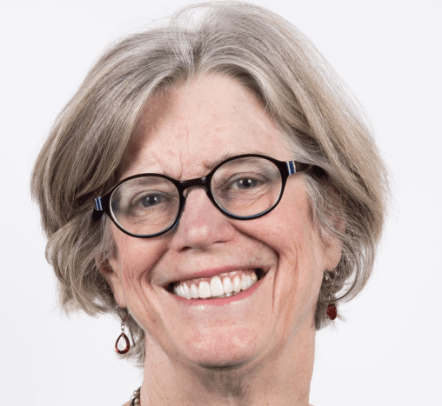
When we talk about hearing loss, everybody benefits, ourselves not the least. This was the message of the January New York City Chapter meeting of HLAA. As President of the chapter, I facilitated the discussion, and it was really great! So many interesting voices, sharing stories of challenges and successes.
Like many people with late-onset hearing loss (mine started when I was 30), I didn’t talk about it for years or, when I did, I minimized it or made a joke about it. That caught up to me, of course. As the loss got more severe, I continued to make jokes. But they fell flat. Even if people didn’t know I had hearing loss, they did know that something was wrong. But not exactly what it was. Dementia? Was I just plain rude? Bored, burned out?

Obviously I didn’t want to seem demented – or any of those other things. When I finally started talking openly about my loss, it was a huge relief, to others as well as to myself. But there’s another benefit of honesty about your hearing.
Once people know what the problem is, they try to help. Sometimes you have to guide them to the appropriate way to help, but most are more than willing. They need to speak slowly and in a normal voice. Shouting won’t help, as the title of book says. They need to look at you, so you can read not only their lips but their facial expression and body language. They need to be willing to repeat what you missed. And you need to know the most effective way to ask them to repeat (be specific about what you missed).
The pandemic was especially difficult for those with hearing loss, because we lost a vitally important visual component of speech: the ability to speech read. But it also forced me — and many others — to become more of an advocate for myself. Now I talk about hearing loss all the time.
Doctors’ offices are a good example. Even before masks, a visit to the doctor could be a challenge. I remember one occasion when I had to go to the ER with a dog bite (not my dog!). It was a large urban ER and I couldn’t hear a thing. I just held out my hand and let the doctor take care of it. Even today when I am asked “Date of Birth?” I always stumble. But I quickly pull out my iPhone and the Otter app, and from there on communication is easy.
At first there was resistance to captioning apps like Otter, Google Live Transcribe, Dragon and others. Medical personnel, especially among assistants and receptionists, worried that captions violated HIPAA regulations. Nurses and doctors were more receptive, and sometimes downright enthusiastic. “Cool, how does this work?” It was a relief to them too to know that I heard what they were saying.
The theme of our January HLAA-NYC chapter meeting was self-advocacy: Living with Hearing Loss: Challenges and Successes. At the start of the meeting, I asked people to consider these four questions:
- What was the biggest challenge you faced with your hearing loss, and how did you overcome it?
- Have you made mistakes in your hearing journey, and how did you correct them?
- Where have you encountered the most obstacles in terms of accessibility?
- Has your hearing loss led to unexpected rewards?
Click here to see a captioned video of the program. You can also see descriptions and links to future meetings on the website. If you’d like to share your own challenges and successes, please comment below.
*
You can also read my books:


Discover more from Katherine Bouton: Smart Hearing
Subscribe to get the latest posts sent to your email.

 Katherine Bouton: Smart Hearing
Thank you for this, Katherine, I did not know I could access past meetings of the HLAA-NYC. I plan to catch up!
LikeLike
Katherine, even though my hearing is good, I liked your post. I was especially interested in your interactions with doctors and ER personnel, and your struggle to tell others what you were going through.
Leslie
LikeLike
Passing this along– https://www.theguardian.com/commentisfree/2023/mar/01/my-kids-often-baffle-me-but-at-least-we-agree-on-subtitles
LikeLike
Thanks. This is great. He mentions Spotify, which I’ve been using. All the lyrics are captioned! At least for boomer tracks like Eagles Radio…
LikeLike
You said you pull out your phone and turn Otter on. When I turn Otter on it turns the hearing aids off. How do you prevent that?
LikeLike
Carol, You’re correct, as I discovered myself the other day in a noisy place. But fooling around with apps I found that if the speaker (in this case it was a tour leader) wore my companion mic, I got his voice clearly in my ears and I also got Otter captions on my phone.
LikeLike
Is it the distance that makes the difference between a tour leader and a dinner companion?
LikeLike
I think the reason Otter is more accurate in a noisy place if you’re using the remote mic is because both the mic and the transcript are coming directly from your hearing aid via bluetooth. I could be wrong .. this is just a guess. If you’re in a noisy place like a restaurant, your mic is going to pick up a lot of background noise. Maybe if the speaker held the mic up right next to the mouth there would be less background noise, but that’s not practical in a restaurant.
LikeLike
Hi Katherine:
I have exchanged a few emails with you over the years, and I’m reaching out to see if you know who might be able to assess one part of my hearing loss. I have a severe high frequency hearing loss that in my left ear is in the profound loss range but my right ear is moderate, and using the bad ear (left) hearing aid definitely and significantly increases my ability to register words, so I the potential risk vs. reward for a cochlear implant in my bad ear is not a good idea. However, for the past decade plus, I need to go back to hearing aid specialists for adjustments far more often than almost anyone else, as I’ve been told by more than a few audiologists, so it’s at least partially true. In addition, I recently tried a pair of Oticon hearing aids and they were amazing for about 2 weeks, and then they seemed to deteriorate so that my 4 year old Phonak Marvel’s (highest level) went from being far less effective to much more effective. My wife said this morning that she believes the same pattern keeps happening—that I’ve continue to have a good setting that only lasts from a few days to a few months. I’m wondering if there might be a specialist I should see to try to understand what happens over and over, and I wondered if you might have either knowledge of who I could ask or who I could ask that might know someone else who knows.
Thanks for considering my question,
Mark
>
LikeLike
Hi Mark, I am not an audiologist so really have no idea what might be behind the changes. I think you probably have fluctuating hearing, with changes that don’t seem to relate to anything in particular. I would definitely talk to a cochlear implant specialist — a neurotologist – about whether an implant in that ear would help with the fluctuating hearing. Cochlear implant surgery is safe. I don’t know anyone who has gotten an implant who regrets it. It does take time and practice to adjust to it, but fortunately CI specialists now realize this. When I got an implant in 2009 I was not offered aural rehabilitation — I think that aural rehab is considered standard now. There are good cochlear implant specialists around the country. Most, if not all, are in major medical centers. You do want to be sure the surgeon has done many cochlear implant surgeries before yours. Medicare should pay the cost if you meet their criteria.
LikeLike