
What if cochlear implants were completely internal? No more behind the ear processor, no more magnetized headpiece/transmitter, no more cable connecting the two, no more rechargeable batteries. We’re partway there with Cochlear and Med-El’s single-external-unit implants, which have just the headpiece. Advanced Bionics is said to have a single-unit implant on the horizon. But in early October, a completely internal C.I. got a little closer to reality.
Envoy Medical, Inc. a Minnesota based hearing-health company, received approval from the FDA to expand its clinical trial of a fully implanted cochlear implant, the Acclaim. The receiver, processor, battery are all under the scalp. It’s still in the testing stage, and this particular item may never make it to market, but it shows that it can be done. And if it can be, it probably will be.
Would you want it? Maybe, if it was affordable and covered by insurance. The Envoy Esteem hearing aid, also totally internal, costs $40,000 and is not covered by insurance. The Acclaim is still in clinical trials so there is no price point and no insurance information as yet.
Envoy’s early marketing highlights appearance as a major plus for the Acclaim. “By removing external hardware, the Acclaim is designed to reduce visible stigma and improve adoption rates among potential candidates.”
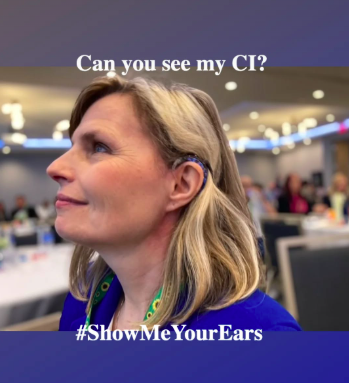
Stigma, of course, can be an issue with cochlear implants, but for most people the gain in hearing is worth the clunky headgear. Some people embrace their implants, like Shanna Groves, pictured here. Her C.I. is decorated with a blue butterfly decal (bought on Etsy) and she’s wearing a lanyard with a yellow sunflower to show that she has an invisible disability. I used to have Monet’s Water Lilies on my cochlear implant. Now my device is a vibrant purple.
Still, there may be more substantive reasons than vanity to want an internal device. Personal safety is a major factor. Most people remove their cochlear implants and hearing aids when they go to bed at night. If they live alone, they may rely on bed shakers or vibrating watches to alert them to alarms or the phone ringing. But being able to actually hear your surroundings at night is important to many.
Your lifestyle may make wearing a cochlear implant challenging. If you play active sports, you have to find a way to anchor the earpiece and sometimes also the headpiece. I have never been able to do this when I am doing mat exercises on my back, so I take the processor off. If you do water sports you can get a special implant, but water sports would have to be a major part of your life. Most people would choose to simply take a convention implant off when swimming. Some kinds of helmets can be a problem with a cochlear implant. And for some people the issue is indeed visibility.
One of the early Acclaim trial recipients, Michael, a military contractor, said in an Envoy video that he’d considered a conventional cochlear implant 10 years ago, but he backed out on the day of the surgery. Visibility was an issue – he has a shaved head. He also mentioned personal safety, as well as the fact that he’d feel restricted engaging in active sports like ice hockey.
Michael made one other point that would be a plus for many people. The acclaim is a middle-ear implant and the sound comes in through the ear, not digitally via the brain as is the case with a conventional cochlear implant. I have no problem with the way my C.I. sounds but many people say voices sound robotic, at least at first.
The Acclaim is intended to be a middle-level device for people who need more than a hearing aid but not yet a conventional cochlear implant. It will not be for me. My hearing loss is too severe and I already have an Advanced Bionics cochlear implant. I’ll continue with that brand if I get a second implant.
But although appearance is not a factor for me, not having to worry about knocking off the behind-the-ear processor is. I could devote a full column to the many times I’ve accidentally dislodged the earpiece from behind my ear.
I do like the idea of hearing at night. On the other hand, I really enjoy the silence of my morning coffee time before I put on my devices for the day.
***
For more about living with hearing loss, read my memoir Shouting Won’t Help, and for more practical advice try Smart Hearing. Both are available as Kindle or paperback.
Discover more from Katherine Bouton: Smart Hearing
Subscribe to get the latest posts sent to your email.

 Katherine Bouton: Smart Hearing
thanks, Katherine!
>
LikeLike
Thanks for reading!
LikeLike
I love the fact that people feel stigma cuz of a ci but not their glasses!!
I find the idea of an internal ci attractive. Makes it easier to use head phones – nothing special like today. My ci falls off in the dentist chair sometimes – not the processor just the ear piece. I once took a hat off (cavalierly) and the ci flew off. So many pluses for internal.
LikeLike
I take mine off before I even get into the dentist’s chair. I once took a hat off on a snowy walk and the c.i. fell off without my knowing it. A few hours later someone put a notice on the community chat board that they’d found a “hearing aid” — close enough. And the snow hadn’t damaged it in the least.
LikeLike
Being able to wear hats would be a lot easier. I manage to knock mine off at crazy times then do a wild dance trying to catch it. I’d love not having to do that – especially in public.
LikeLike
Have I told you lately what a star you are? No? Well I’m doing it now. This article was so heartening to read. Now I’m less anxious as I contemplate a possible further decline in my ability to hear. Judy Lee
LikeLike
Wow, thank you so much! Where do you live now? Do you have my email address? Would love to see you.
LikeLike
One Sunday I didn’t realize a church sister wore the C.I. and when I gave her a hug, my fingers caught in it and pulled it out! She took it well and it opened a whole conversation on the pros and cons of being hearing impaired, not knowing that in a few years I’d lose my hearing! My question with the new implants is if necessary, how would adjustments be made. I’ve had to have numerous adjustments to my HAs and they still could use more! By some miracle will the new implants work right out of the gate?
LikeLike
I’m not an expert, and I didn’t speak to the company to write this since I wanted it to be about the concept of an invisible C.I. rather than about the Envoy Acclaim. But my guess is that you’d go through all the regular advance testing and then the fine-tuning would be done the same way it’s done on a regular c.i. — on the audiologist’s computer. This product is not for severe to profound loss, however — it’s important to remember that. The company sees it as a midway step between hearing aids and cochlear implants.
LikeLike
I was only hearing about 9 % in the ear that now has a cochlear implant. I’m wondering if my other ear starts to become worse, how much longer would the recovery time be, since it seems like more of the operation would involve further cutting to place the gadgets under the scalp.
I got off fairly easily because I had a perforated eardrum, having had a tube in my ear, and it seemed to alleviate a lot of the after-surgery pressure.
LikeLike