One of the most interesting parts of my role in New York’s hearing-loss community is interacting with the larger disability community. Through committees like the MTA’s Advisory Committee for Transit Accessibility (ACTA), I see first-hand the obstacles that people with other disabilities face.
When The New York Times asked me to write about how New York City museums serve people with disabilities, I accepted with enthusiasm. I knew about accommodations for people with hearing loss, but I had no idea how much else was offered. New Yorkers have a huge range of disabilities, visible and invisible, and many are addressed by our cultural institutions.
The article is online now and appears in print in the Sunday April 30th paper. It’s called Making Art Accessible for All, although more accurately it would be “Trying to Make Art Accessible to All.” It’s a challenge.
On Sunday March 12, I joined a group of people who were blind or had low vision for an afternoon of activities designed especially for them, which would set the scene for looking at the larger issues. I worked for The Times for most of my journalism career, both writing and editing. In 2009 I took a buyout shortly after I got a cochlear implant, because I couldn’t hear well enough with my new cochlear implant to function fully in that noisy and competitive workplace.
When the Times asked me to write this article, almost 14 years later, I felt confident about going back out into the reporting world. I hear well with my hearing aid and cochlear implant, and I was eager to meet new people and try out new situations.
The reporting went well, thanks to technology. The Innocaption app on my smart phone allowed me to do telephone interviews. Google Meet interviews were captioned. A couple of in-person interviews were made easier by the Otter app. Innocaption and Otter also provided me with a transcript to review later. Text to voice technology allowed the blind to read my emails. It was exciting to see how far technology has taken us.
Ironically, there was one situation where my disability tripped me up, and that was at MoMA’s afternoon event for the blind. The museum was packed with happy chattering people and the noise bounced off the walls and ceiling and floors – and even off some of the art. Otter was as overwhelmed as I was by the ambient noise, and I ended up hearing very little. I could have asked for a CART transcriber to accompany me, but I didn’t think of it. It’s always the things we don’t think of that are the problem.
Luckily I was able to follow up with phone calls and emails and all was well. But for a brief period that afternoon, I was reminded that my hearing loss is a disability. Sometimes I forget because life has gotten so much easier thanks to technology and accessibility.
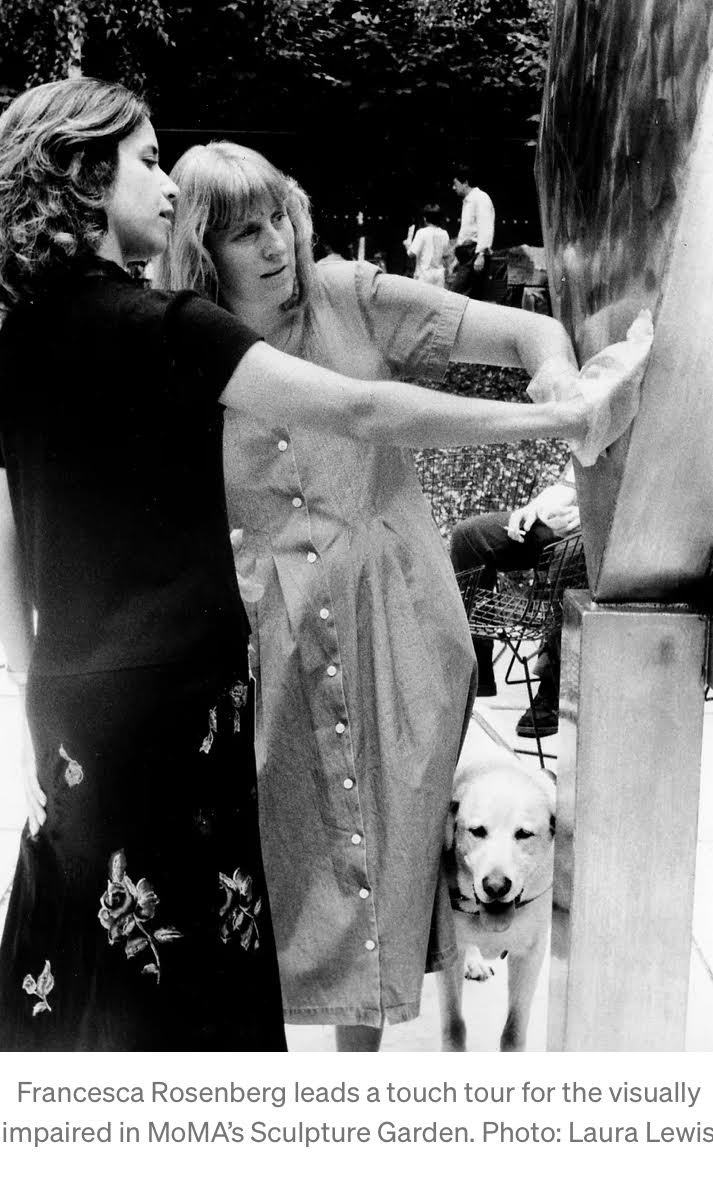
A note about the photo: Francesca Rosenberg is now MoMA’s Director of Access Programs and Initiatives, and oversees all of MoMA’s wonderful accessibility programs. This photo was taken in 1995.
*
For more about living with hearing loss, you can also read my books:


Strategies, Skills, and Resources for Living Better with Hearing Loss.
Discover more from Katherine Bouton: Smart Hearing
Subscribe to get the latest posts sent to your email.

 Katherine Bouton: Smart Hearing
Yes, I feel lucky to have access to so much new technology that I’m occasionally able to forget that I have a severe hearing loss. However, I have been reminded recently because one of my Bluetooth enabled hearings aids was sent out for repair and my backup pair is on the fritz too. I’ve spent the last 7+ days struggling through phone & zoom calls, lunch dates, meetings and medical appointments. Last night I had to confess to my chatty Uber driver that I couldn’t understand a word she said. I’m counting the hours and minutes until I can pick up my hearing aid and function in the world again!
LikeLike
Thank you for your excellent article in the NY Times, Katherine. Although there are still problems, we have made a LOT of progress. Francesca Rosenberg, pictured on the left, has been the Director of Access Programs at MoMA for more than twenty five years. HLAA NYC Board members Joseph Gordon, Mary Fredericks and I and Arlene Romoff of NJ HLAA, were part of the first Access Advisory Committee for People With All Disabilities Francesca created at MoMA in the late 1990s. I have also been a member of the Museum Access Consortium (MAC) and can attest to the excellent work it does in creating access to cultural organizations throughout the New York area. There are branches of MAC across the country working to help people with disabilities.
LikeLike
Can you post the article? I am not a NYT reader but would like to see it
LikeLike
Sure. Thank you for pointing that out.
LikeLike
Thank you for amazing article. I highly recommend the arts organisation ‘Creative Growth’ based in California ‘Founded in 1974, Creative Growth is a leader in the field of arts and disabilities, establishing a model for a creative community guided by the principle that art is fundamental to human expression and that all people are entitled to its tools of communication’. https://creativegrowth.org.
LikeLike
Thanks Sherree. I came upon a similar organization when reporting this. Inclusive Citymaker: https://www.inclusivecitymaker.com/how-to-make-museums-more-accessible-for-people-with-disabilities/
I hope the link works.
LikeLiked by 1 person